

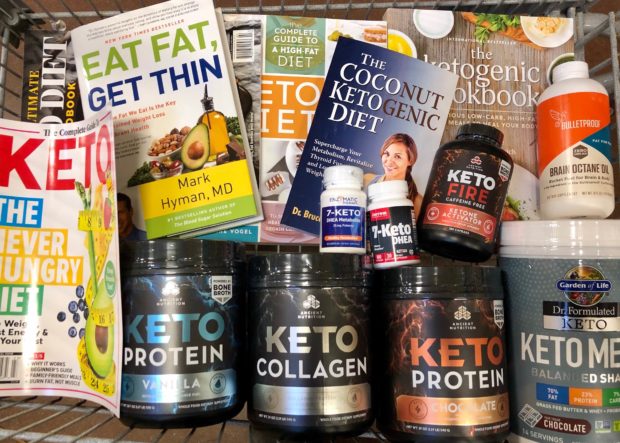
The ketogenic diet was the most popular diet searched on Google in 2018 and has officially reached mega-fad status – as did the Atkins Diet, in its heyday.
If you don’t know what the ketogenic diet is, there are, by my estimation, 1.2 zillion articles about it online, so I’m not going to go into great detail explaining it here. But simply put, the ketogenic diet consists of 70-80% fat, a “moderate” amount of protein, and near-zero carbohydrates.
A true ketogenic diet keeps your body in “fat-burning mode” 24/7, which can be verified by daily measurement of ketone levels in your urine. Dietary ketosis is difficult to maintain, and the term “ketogenic diet” is now widely misused by people eating a low-carb diet without actually being in ketosis.
If you think you are eating a ketogenic diet and you aren’t monitoring your ketone levels, you probably aren’t in ketosis and eating a true “ketogenic diet”.
In 2012, I thought the ketogenic diet might be a viable anti-cancer diet, but I was wrong.
Before I dig into the research on the ketogenic diet for cancer, I need to say this…
Obesity is the second leading cause of cancer.
If you are overweight, getting down to a healthy weight range with a normal BMI will improve your health and reduce your risk factors for cancer and many other chronic diseases. I have never met a doctor or health expert who didn’t agree with that statement.
It is also understood that every weight-loss method improves various aspects of your health in the short term. Typical improvements associated with weight loss include reductions in inflammation, hormone levels, blood pressure, cholesterol, and blood glucose, as well as the reversal of type 2 diabetes and other benefits.
Repeat.
Every weight loss method improves your health in the short term.
You can lose weight quickly with a crystal meth habit, and health issues related to obesity will likely resolve. But no one in their right mind would attribute the benefits of weight loss to meth, which brings us to the ketogenic diet.
There is no population of people on planet Earth who eat a ketogenic diet and have long lifespans.
Even the Inuits/Eskimos, who eat high-fat diets, are not in ketosis. And they have short lifespans to boot! Theirs is not a diet you want to emulate.
A 2018 study found that people who follow low-carb diets have shorter lifespans (4 years shorter on average), unless they follow low-carb plant-based diets. Here’s a quote from the study conclusion…
“Low carbohydrate dietary patterns favouring animal-derived protein and fat sources, from sources such as lamb, beef, pork, and chicken, were associated with higher mortality, whereas those that favoured plant-derived protein and fat intake, from sources such as vegetables, nuts, peanut butter, and whole-grain breads, were associated with lower mortality…”
Another 2018 study reported that people who ate the lowest-carb diets had a 32% increased risk of death from ANY cause than those eating the highest amount of carbs.
The same study also found that low-carb dieters had a 51% increased risk of dying from heart disease and a 35% increased risk of dying from cancer, compared to people who ate the most carbohydrates.
In 2016, the results of the NUSI metabolic ward study were published, where low-carb diets were tested against low-fat diets for weight loss in humans. Gary Taubes and Dr. Peter Attia, the founders of NUSI, were both low-carb diet promoters, and this study was meant to prove that low-carb eating was superior for weight loss, but it actually found that low-fat diets worked better!
Perhaps the most egregious hypocrisy is that many health and wellness influencers currently making money promoting the ketogenic diet aren’t even following it. And the authors of several bestselling ketogenic diet books are obese! (I’m not going to call them out here, because I’m nice.)
Ditching processed food and animal food and adopting a naturally low-fat, whole-food, plant-based diet rich in fruits, vegetables, legumes, nuts, seeds, and whole grains will do wonders for your health. It’s a sustainable, long-term health-promoting diet. And you will lose weight without even trying.
To sum it up, low-carb and ketogenic diets will produce weight loss, but not as much as low-fat diets. And they are terrible for you long-term. And they increase your risk of an early death.
Having said all of that, there is tremendous value in short-term ketosis induced by a 3-5-day water fast or the plant-based ProLon Fasting Mimicking Diet. Both have numerous benefits in the body, including autophagy, stem cell activation, and immune system regeneration. You can learn more about that in my interview with world-renowned scientist and longevity expert Dr. Valter Longo here.
But what about the ketogenic diet for cancer?
The ketogenic diet has dominated the cancer conversation in recent years, thanks to the rapid dissemination of misinformation on the internet by opportunists, fad exploiters, book and supplement sellers, and a few well-meaning people.
So, let’s go straight to the science… (Don’t take my word for it. Click through and read the studies!)
There are several studies in which researchers implanted human gliomas (brain cancer) into the bodies of rats (a completely unrealistic scenario for humans) and reported that the rats lived longer on a ketogenic diet. After these studies were published, the keto for cancer feeding frenzy began.
As you will see, the results of the rat studies appear promising, but the human studies… not so much.
A 2011 pilot study involving 16 human patients with advanced cancer stated that the ketogenic diet “might improve aspects of quality of life and blood parameters,” but the patients did not live longer, and none were cured.
In this 2012 study, rats with human brain cancer implanted in their bodies achieved complete remission when fed a keto meal replacement shake called KetoCal and treated with radiation. Rats treated with a ketogenic diet (KetoCal) but without radiation only lived 5 days longer than standard diet rats.
In this 2013 study, rats with human brain cancer implanted in their bodies lived 56% longer on a ketogenic diet combined with hyperbaric oxygen therapy. “56% longer” sounds huge…until you learn that the average keto+oxygen therapy survival was 55 days compared to the control rats who lived 31 days. And all the rats still died of cancer.
This 2012 study showed that tumors can use ketones for fuel. Despite the widespread myth that “cancer cells can’t use fat for fuel,” they most certainly can and do. Many types of cancer cells are metabolically flexible. If you starve them of glucose, it can weaken or slow them down temporarily. But they will eventually adapt to using fatty acids or amino acids (like glutamine) for fuel by upregulating pathways such as F.A.S. (Fatty Acid Synthesis), SREBP 1 and 2 (sterol regulatory element-binding proteins), mTOR, Glutaminolysis, and more.
This 2014 study found that a ketogenic diet helped the anti-angiogenic chemo drug bevacizumab work a little better for glioblastoma in humans, but had no effect alone.
According to a 2015 review of the literature on the ketogenic diet for human glioma patients (32 case studies), “Prolonged remissions ranging from more than 5 years to 4 months were reported in the case reports. Only one of these patients was treated using the ketogenic diet as monotherapy. The best responses reported in the more recent patient series were stable disease for approximately 6 weeks.” As I said, in some cases the keto diet might slow the cancer down for a bit. But then it adapts and keeps growing.
The ketogenic diet can speed up cancer growth.
A 2017 study published in Cell found that a genetic mutation called BRAF V600E allows cancer cells to use ketones to grow faster. This mutation is present in 50% of melanomas, 10% of colon cancers, 100% of hairy cell leukemias, and 5% of multiple myelomas.
A 2018 study found that mice with acute lymphoblastic leukemia treated with vincristine that were put on a low-fat diet had a five-fold higher survival rate than those on a high-fat diet. The mice on a low-fat diet had a 92 percent survival rate, while the mice on a high-fat diet had a 17 percent survival rate.
This 2018 study found that the ketogenic diet, combined with PI3K-inhibiting drugs, slowed tumor growth in mice better than the drug alone. But the mice given the ketogenic diet alone had accelerated progression of acute myeloid leukemia. The keto diet made the cancer grow faster.
Another 2018 study found that fat fuels aggressive brain cancers. Slow-dividing glioblastoma cells, which are more invasive and resistant to chemo and radiotherapy than fast-dividing cells, use fat (not glucose) for energy.
This next study is really important.
In December 2018, a review of ALL published studies using the ketogenic diet for cancer in humans was published. It found that clinical trials using the ketogenic diet for cancer have “largely failed to prove survival-prolonging effects.”
“Yeah, but that was seven years ago.” Keep reading.
A 2019 study found that a ketogenic diet suppressed the growth of squamous cell lung cancer in mice compared to control, but did not affect the growth of adenocarcinoma lung cancer. The ketogenic diet did not cure or reduce the disease. According to the study authors, “There was no tumor regression by ketogenic diet alone.”
Another 2019 study found that a ketogenic diet was “feasible and safe as an adjuvant to chemoradiation treatment” for humans with glioblastoma multiforme, a notably weak conclusion. In addition, the overall survival was shorter than similar keto studies (12 months versus 15-20 months). Authors of a paper reviewing that study hypothesized that the patients didn’t live as long as comparable studies because, for the first six weeks, they were almost exclusively fed a highly artificial ketogenic diet in the form of a highly processed liquid food product called KETOCAL.
A not-specifically-keto, but still relevant 2019 study found that prostate cancer patients who had the highest levels of saturated fat in their diets were four times more likely to die from prostate cancer compared to patients with the lowest saturated fat intake.
Speaking of prostate cancer, check out my interview with Dr. Dean Ornish, who proved that early-stage prostate cancer can be reversed in humans with a naturally low-fat, whole-food, plant-based diet, exercise, and stress reduction.
A 2021 study on 80 breast cancer patients found that patients with locally advanced disease (stage 1-3) who were put on a ketogenic diet for 12 weeks responded better to chemotherapy than those who ate their normal diet. They had more tumor shrinkage and down-staging of disease. That is a positive result, but more short-term tumor shrinkage doesn’t mean a cure. In addition, the patients with metastatic disease had no significant response difference from the ketogenic diet. We don’t know how any of these patients fared after the three-month study.
A 2023 study in mice found that a high-fat diet changes gut bacterial composition for the worse, increasing Ileibacterium valens and Ruminococcus gnavus, which results in increased inflammatory bile acids and downregulation of the farnesoid X receptor (FXR), which in turn negatively affects the proliferation of intestinal stem cells, all of which increase the risk of colorectal cancer.
A 2024 study found that mice with breast cancer fed a ketogenic diet for seven weeks had more reduction in primary tumors, but experienced significantly more lung metastases than mice on a normal diet. Study author Wei Gu, PhD, and his colleagues determined that glucose starvation leads to up-regulation in BACH1-modulated pro-metastatic genes. Essentially, starving a cancer tumor of glucose triggers changes in cancer cells that make them more prone to spread to other parts of the body. Not good!
A 2025 study that looked at the NHANES health data of 43,838 adults over 18 years reported that ketogenic diets are associated with as much as a 29% increase in risk for all cancers, but that study was retracted after methodology concerns were raised by peers.
A 2026 study on mice found that “obesogenic high-fat diets enhance small-intestinal stem cell activity and tumorgenesis” and that the ketogenic diet accelerated tumor growth and shortened survival.
A 2026 paper by Thomas Seyfried, PhD, proposes that a blood biomarker called the Glucose Ketone Index should be used to monitor patients’ level of ketosis during cancer care. Fourteen years after his influential book Cancer as a Metabolic Disease (now out of print) was published, I would expect to see studies and papers from him on improved cancer survival and exceptional remission rates validating his dietary hypothesis, but no. The fact that Seyfried, widely regarded as the authority on the ketogenic diet for cancer, still hasn’t published papers or a monograph of long-term remission case reports speaks volumes.
In summary, the ketogenic diet has repeatedly been found NOT to cure cancer in rodents or humans. It has been found to increase cancer risk and accelerate growth in multiple types of cancer.
It is my opinion that the best evidence-based anticancer diet – which I discuss at length on this site and in great detail in my book – is an organic, whole food, plant-based diet centered around the foods with the highest concentration of anticancer compounds like cruciferous and allium family vegetables, berries, legumes, mushrooms, and more. Why? Because I know lots of holistic survivors, myself included, who have healed all types and stages of cancer with that exact dietary strategy. I’ve interviewed roughly 100 of them for you here. Use the search bar up top to find healing stories for specific cancer types.
We can learn from the experience of others.
If you want to be successful, imitate successful people. If you are serious about healing or preventing cancer, I want to encourage you to incorporate the diet and lifestyle strategies consistently used by people who have reversed cancer against the odds. I’ve interviewed so many… Use the search bar up top to search for specific cancer types and learn from successful survivors!
…
I created a coaching program and a private online support community to help you survive and thrive through cancer. The SQUARE ONE Program contains the step-by-step strategies used by myself and many others who have healed cancer with a holistic approach using evidence-based nutrition and natural non-toxic therapies.
